Saturday, September 7, 2013

Earthan Beds

Over the past 21 months I have experimented with variations and combinations of Aquaponics, (vertical towers, wicking pots, deep water culture, and media beds), plus several other gardening methods such as Bio-Ponics, Wicking Beds, Hugelkultur, Two forms of Hydroponics (Dutch Bucket Hydroponics, and Kratky Method), and Dirt.


What I discovered worked best for me was all of the 'ponic' methods -Aquaponics, Hydroponics, and Bio-Ponics The Kratky Method (a form of Hydroponics) also worked well, but the Kratky Method is limited to quick crops of leafy greens.


Wicking beds or Wicked Beds as the Aussies like to say,  provide uniform moist soil,  even when I forget to water, and they conserve water due to the bottom up watering method.

The 'Ponics' which are not normally soil based, provide nutrient rich water on a regular basis.

I am now ready to combine the techniques that I found worked best for me.  I was working toward this conclusion when I saw this link to the Earthen Group.  The details of this solution were instantly clear to me.  Paul Van der Werf  appears to have worked out all the kinks, and has detailed the construction of his system in the link above.    

http://youtu.be/lkSMkTpdt7U
http://www.earthangroup.com.au/earthan-beds-how-they-go-together/

Since I built my Wicking Beds as conventional raised beds, and used sand in the reservoir I will have to replace that sand with 1-1/2" drainage rock in order to facilitate the faster movement of water from the Bio-Ponic or Aquaponic system.  I'm leaning towards Bio-Ponics because I'm not into eating fish, and it comes with less overhead.  Either way the nutrients will flow below the soil in the Wicking Beds.

This should create a very large area for nitrification, and be very good for the fish if I choose that path.

I considered utilizing one bed for the soul purpose of vermicomposting  Eisenia Hortensis (European nightcrawler) or more likely Eisenia Foetida (the red wiggler, Californian red worm).  But the leachate from a worm bin would not be beneficial to an aquaponic or even a bio-ponic system.

Converse  wrote a very good description of the risks involved. [LINK]


To be clear-  keeping red wigglers in all of your grow beds is a good idea, but the leachate created in composting worm bins is better suited for a Bokashi Compost than used directly in the garden, or introduced to aquaculture, so even though it may sound like it would increase the micro-nutrients in the soil, it is not recommended.

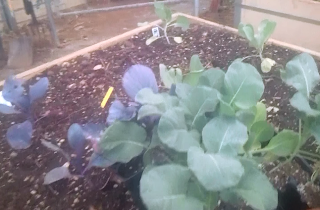
Since I first made this post I have converted two of my wicking beds to Earthan Beds.  They are working very well.


Some Pictures


Thursday, August 29, 2013

Aquaponics Is Not A Sustainable Form of Agriculture


Aquaponics has been touted as a way to save the world from the destructive and wasteful agriculture practices used on most commercial farms which is clearly not sustainable.. But just as raising cattle for meat, raising fish on farmed grain is also costly to the environment.
 
Much of the grain used to produce fish food is GMO;  raised using large amounts of fossil fuels for fertilizer and machinery in order to produce a profit while neglecting the environment.

Perhaps aquaponics will find a place in outer space, but while we are still here on Earth, aquaponics will remain a romantic attraction blindly portrayed as sustainable, and ecologically sound by those who fall in love with the technical wonder of soil less gardening.  For some the full experience includes the ability to automate, and record  data from sensors.

Clean, neatly segmented water processing stations each providing an optimum environment for bacteria, roots and water quality at the expense of outside energy and natural resources.  Computerized systems can even be monitored and operated remotely from a smart phone miles away.
 
Certainly easing the harvest of wild fish is a good thing, but we often overlook the large picture. Kinda like growing corn for ethanol. What a short sighted idea that was. Aquaponics is not easing the harvest of wild fish as well as it appears. The food we feed to the fish is made from wild caught fish. And while that source is comprised mostly of fish with little commercial value, and waste from the processing it still places a burden on the wild fish population. For more about the analysis of fish food read http://www.oscarfish.com/fish-food-ingredients.html.


Aquaponics uses less water than soil based farming, but it comes at a cost is the environment, and fossil reserves which seems to be overlooked. All along I have promoted energy efficiency in aquaponics, but the numbers still come up short as I demonstrated in another article 'Energy to Produce Vegetables' .  The caloric value of the food produced does not match the energy required to operate an aquaponic system. The pumps require more energy than is grown by a very large factor; sequestering far less carbon than it releases. Some aquapons are supplementing light, and heat during the cold season. This puts aquaponics so far into energy debt that it becomes absurd.

This government funded aquaponics research system has deep pockets and no regard for wasted energy


Bottom line - aquaponics is fun, it's interesting, but it's not saving the world as a sustainable form of agriculture.

So what can we do?  The answer lies in simply helping, and growing with nature rather than in spite of nature.

Plant in soil, according to the seasons.  Conserve water by creating collection and recollection areas,  use green mulch,  alternate and grow companion crops, build healthy soil with micro-nutrients, and microorganisms, never let the soil lay bare,  Use only safe pesticides if needed.  Never waste a good thing - compost and use compost tea and EM.   Use bio-char,  humus and rock minerals.  Gather leaves in the fall or just let them provide the natural benefits to your soil by leaving them alone.  Pay attention to micro-climates, and take advantage of shady areas near fruit trees.  Let some beneficial weeds grow in order to bring nutrients up into the top soil.  Love the worms and bees, and feed them well.  Plant flowers among your vegetables.  Do not till your soil.


Wear sun block, and a hat!
Wicking beds and Hugelkultur beds conserve water

The Basics of Natural Farming


The common theme between Hugelkulture and Wicking Beds is water supplied from below the soil.  These are both considered Permaculture.  It may very well work in our favor to integrate these methods with aquaponics.  This new hybrid system is called Earthan Beds

Thursday, August 22, 2013

Airlifts, Geysers and AquaZen

I want to begin by saying I am not an expert with airlift design.  My results  differ from others who have spent more time experimenting with airlift technology.

I like airlifts because they are less expensive to operate and can be built for only a few dollars.   Airlifts aerate the water and are able to pass objects such as way ward fish without clogging.  They have no moving parts; instead they rely on an external air pump which would in most aquaculture systems already be present.

In the video below I experimented with three types the pumps.  A simple Airlift, a Geyser Pump and an AquaZen Airlift.  This video documents the results.

This video shows me running five different airlift configurations.
All of the designs performed very close to each other.
Some factors that may be influencing the differences are the diameter of the pipes and the number of turns.
Each test was performed with a 200 lpm EcoPlus 7 air pump running at 93W.
The vertical pipe was submerged 24-1/2" and the rise was 13-1/2" +/- 1"


Test #1 Simple Airlift with Separator - 5 gal/62 seconds
Test #2 Simple Airlift w/o Separator - 5 gal/58 seconds
Test #3 Geyser with Separator - 5 gal/74 seconds
Test #4 Geyser w/o Separator - 5 gal/50 seconds
Test #5 AquaZen - 5gal/58 seconds

In each case the separator appears to actually reduce the performance. Sorry I did not run the Aquazen test without the separator.  I believe the loss of performance is due to my design and I will try to make this part more efficient.

The Geyser and Simple Airlift performed as well or better than the AquaZen. But there are many factors that may have been overlooked. As far as I know the check valve was installed correctly and there were no significant leaks. The submersion and rise were kept within a 1" tolerance and the barrel was filled to the top each time.

I hope others will take the time to build and test these, and other airlift pumps. More data might help. It may also be that they each operates best at different lifts. I still have so much to learn

Saturday, June 29, 2013

Low Energy System Design


...Download this Sketchup Model..

This system has two radial filters and a media bed to keep the deep water culture raft very clean, An airlift pump keeps the water moving via an air compressor; no mechanical water pumps are required

Water levels in all the tanks are the same. By not raising the water from a sump tank only a small amount of energy is required to move the water laterally.

If this entire system were buried flush with the ground the thermal mass of the earth would help regulate the temperature very well during both summer and winter 


Airlifts  provides both water circulation and aeration. I believe airlift pumps can be more efficient than an external pump.  (I've never understood why submersibles are always less efficient, but the specs tend to indicate this).
Airlifts can be calculated.
This article Performance Study of an Airlift Pump with Bent Riser Tube presents an interesting conclusion is that bends in the riser pipe do not effect the performace of an airlift pump.
OPTIMIZATION OF A BACKYARD AQUAPONIC FOOD PRODUCTION SYSTEM
is a very good paper about aquaponics and it would be a very good source for information about airlift pumps but a critical table is missing.  I'd still recommend reading it for everything else it presents.


I found this calculator for airlift pumps.  It is spot on against the real life experiments I've conducted.

From my own experiments without math; I believe an airlift will provide enough water circulation.  That is also what Keith Tatjana demonstrates in his paper in which he assumes a circulation rate of one fish tank volume twice per hour.
I think air blowers are more reliable than water pumps, and less expensive.  Blowers do not provide the pressure like a compressor so this is a limiting factor when using a blower, but if at all possible use an air blower because air compressors like the Hydrofarm 70 and 110 lpm units tend to vibrate themselves to death.
I have not done any experimentation with how much ambient air temperature will affect the water temperature, but logically this would occur whether it be from an air stone or an airlift pump.
Other papers I've found are
Performance Characteristics of Airlift Pumps withVortex Induced by Tangential Fluid Injection
Explore the Potential of Air-Lift Pumps and Multiphase  
Explore the potential of air-lift pumps 

A geyser pump, an improved airlift pump
The Geyser Pump improved the amount of water pumped from 40 gpm to 60 gpm in one experiment I conducted.  

This Video shows the Geyser Pump I built. http://youtu.be/ztHBHULkHNQ


Saturday, June 15, 2013

Drums

Nice Clean Design
I like the way these drums are supported.  In the past I've always seen drums supported from below.  This looks strong to me and the clutter of support beams has been eliminated.  
This span proved to be a bit too long.  Support will be added in the middle


I'm not advocating the use of non-food grade drums, but recently I was given quite a few.   I did some looking into the hazards of the contents which were products used at a car wash.  One of the barrels was very clear about not reusing the drum and so I will not reuse it.  But I still question the reason for the warning.

If you want barrels look for free drums at food processors and restaurants.  Here is Chico we are lucky to have Smukers / R.W. Knudsen where we can buy various food grade containers for only $5.00


Here is what I found

The Rain X and Blue Coral drums contain Butoxyethanol which causes damage to the following organs: blood, kidneys, liver, lymphatic system, upper respiratory tract, skin, central nervous system, eye lens or cornea.
Butoxyethanol appears to be toxic in high doses of 100-500ppm, but 2-Butoxyethanol usually decomposes in the presence of air within a few days, and has not been identified as a major environmental contaminant. It is not known to bioaccumulate
These products are not required to list it on the label when diluted to a certain point. The safety of the products as normally used is defended by the American Chemistry Council and the Soap and Detergent Association, industry trade groups.


Blue Coral Lo pH Conditioner Yellow

"Empty containers retain product residue and can be hazardous. Do not,reuse container. "
This warning says it all, but from the list of ingredients it seems that only the sulfuric acid gives reason for such a strong warning.
Contains:
Sulfuric Acid
- highly corrosive strong mineral acid
Cocamidopropyl betaine - A synthetic surfactant used as Antistatic Agent; Hair Conditioning Agent; Skin-Conditioning Agent
Benzenecarboxaldehyde
, - artificial almond oil.  It is not considered an air or water pollutant nor is it considered toxic.  None of the chemicals in this product are considered highly hazardous by OSHA.


DEF
- Diesel Exhaust Fluid
Contains:
Urea -
Diesel Exhaust Fluid is clear non-hazardous liquid
Appears to me to be relatively safe when diluted.

Super Suds 6062
Contains:
Potassium Hydroxide commonly called caustic potash is used in hand soap and appears to me to be relatively safe when diluted.
Sodium Metasilicate
is used in wine and beer and appears to me to be relatively safe when diluted.
Sodium Phosphate, Tribasic  - TSP is a common household cleaning product and
appears to me to be relatively safe when diluted and rinsed clean.

Blue Corral Velocity Clear Coat Protestant
Contains:
Butoxyethanol - See description above

Blue Coral Clear Coat Polish
Contains:
Butoxyethanol - See description above
Propan 2 ol  is Isopropyl alcohol aka 'rubbing alcohol'.


Rain-X Online Protectant
Contains:
Butoxyethanol - See description above
Propylene glycol (PG or MPG)   - A colorless, odorless liquid which is generally recognized as safe (GRAS) by the U.S. Food and Drug Administration (FDA) in 21 CFR § 184.1666, for use as a direct food additive under the conditions prescribed. It is approved by the U.S.
Acetic Acid is an acid which is caustic in high dilution but in diluted forms such as vinegar it would seem relatively safe.