Monday, April 21, 2014
Frogs have an anti-bacterial bio-film on their skin

Monday, February 3, 2014
Using Humona (human urine) for Fertilizer
When I read this article I felt validated. I've been promoting the use of urine and weed tea as a replacement for fertilizer created from petroleum. Urine contains nitrogen and phosphorous as well as many other trace elements necessary to plants.
In order to sanitize urine, it can either be stored for 30 days in a sealed tank at room temperature, or heated for 30 minutes in a solar pasteurizer.
I work at home so I was able to save about 70% of the urine I produced, and in 2013 I easily filled a 55 gallon drum. This will drum remained sealed for at least 3 months.
Since the urine is added the system's water and the water wickes up through the soil I see no possibility of contamination, but others may not feel comfortable so I will let the humona (human urine) age for their peace of mind.
http://news.nationalgeographic.com/news/2014/02/140202-peecycling-urine-human-waste-compost-fertilizer/.
In order to sanitize urine, it can either be stored for 30 days in a sealed tank at room temperature, or heated for 30 minutes in a solar pasteurizer.
I work at home so I was able to save about 70% of the urine I produced, and in 2013 I easily filled a 55 gallon drum. This will drum remained sealed for at least 3 months.
Since the urine is added the system's water and the water wickes up through the soil I see no possibility of contamination, but others may not feel comfortable so I will let the humona (human urine) age for their peace of mind.
http://news.nationalgeographic.com/news/2014/02/140202-peecycling-urine-human-waste-compost-fertilizer/.
Tuesday, January 14, 2014
Nutrient Imbalance
Nate Storey has done it again!
Figuring out nutrient imbalance is in my opinion the most difficult thing about aquaponics. Nate really lays it out in an easy to understand method for us to determine a course of action when our plants begin to look a bit peeked. I would post the link to the KEY he has developed for diagnosing these problems right here, but I feel that you should go to Nate's site and find his offer. When asked to register just do it. You will be pleasantly surprised.
Videos by Nate's
Phoshorus
Iron
Calcium
Potassium
Figuring out nutrient imbalance is in my opinion the most difficult thing about aquaponics. Nate really lays it out in an easy to understand method for us to determine a course of action when our plants begin to look a bit peeked. I would post the link to the KEY he has developed for diagnosing these problems right here, but I feel that you should go to Nate's site and find his offer. When asked to register just do it. You will be pleasantly surprised.
Videos by Nate's
Phoshorus
Iron
Calcium
Potassium
Friday, January 10, 2014
Good Air Pump
UPDATE:

I found this air pump that seems to be exactly what most of us would want.
The AP 100 is quiet at 45db.
It pumps 144 liters per minute at zero head pressure
And the pressure is outstanding - 181 inches of water, but they conservatively claim 11 feet!
100 Watts is not bad either.
It even comes with a rebuild kit!
______________________________________________________________________
I found this air pump that seems to be exactly what most of us would want.
The AP 100 is quiet at 45db.
It pumps 144 liters per minute at zero head pressure
And the pressure is outstanding - 181 inches of water, but they conservatively claim 11 feet!
100 Watts is not bad either.
It even comes with a rebuild kit!
______________________________________________________________________
This
General Hydroponics air pump is Extremely Quiet has a lot of pressure (84" of water) which is required for
many air lift situations. 20 liters per minute is not earth shaking but
it's enough to air lift the water for my Earthan Beds.
The quiet operation and psi of this little $69.00 pump really impress me. General Hydroponics does not state in db how much noise is made, but I think it could be placed next to a living room aquarium. The sound of the bubbles would probably be louder than the pump.
http://www.1000bulbs.com/product/95293/GROW-GH2716.html?utm_source=SmartFeedGoogleBase&utm_medium=Shopping&utm_term=GROW-GH2716&utm_content=Air+Pumps&utm_campaign=SmartFeedGoogleBaseShopping&gclid=CN7G2qO-8rsCFcVQ7AodEVIALw
The quiet operation and psi of this little $69.00 pump really impress me. General Hydroponics does not state in db how much noise is made, but I think it could be placed next to a living room aquarium. The sound of the bubbles would probably be louder than the pump.
http://www.1000bulbs.com/product/95293/GROW-GH2716.html?utm_source=SmartFeedGoogleBase&utm_medium=Shopping&utm_term=GROW-GH2716&utm_content=Air+Pumps&utm_campaign=SmartFeedGoogleBaseShopping&gclid=CN7G2qO-8rsCFcVQ7AodEVIALw

Another good air pump is the Hakko. Here are the specs of the six modles they build.
Hakko25 - 21 liters per minute, 17w, 3.7 psi (32dB)
Hakko40 - 51 liters per minute, 40w, 5.5 psi (35dB)
Hakko60 - 68 liters per minute, 63w 6.7 psi (38dB)
Hakko80 - 86 liters per minute, 85w, 7.8 psi (38 dB)
Hakko100 - 105 liters per minute,116w, 6.5 psi (40dB)
Hakko120 - 121 liters per minute,126w, 7.8 psi (42dB
For large air I have used the Active Aqua 70 lpm and the Eco-Plus 7 with 200 lpm. Both of these are very loud. My Active Aqua 70 lpm destroyed itself in less than a year. The Eco-Plus 7 has been in continuous use for about a year and it runs much cooler due to the larger fin size. Eco-Plus 7 is the better pump in my opinion. Mine uses 60 to 90 Watts even though it's rated at 200W. It also will pump to a depth of 84".
I have no experience with the Elemental O2 Commercial Air Pumps but the
571 gph/43 lpm delivers 2.47psi
951 gph/72 lpm delivers 3.48 psi from 41watts
1157 gph/87.6 lpm delivers 4.64psi
1 pound per square inch = 27.6704523 inches of water.
Wednesday, November 27, 2013
Water manifold for a solar heater
Many people get the idea to heat water after attempting to drink from a hose that has been laying in the sun. The water is hot so wouldn't it be easy to get a 100' of black irrigation tubing a coil it up. Yes this will heat water but there are problems involved with this method.
First is poor efficiency. As the water travels the length of the tube it begins to quickly gain heat, but the hotter it gets the slower it gains additional heat. It would be better to use several short lengths to warm the water only as much as you need. Adjusting the optimum length is more than I wish to get into, but with some experimentation you will find a range that suits your needs.
Another problem with one long coil is resistance to flow. The longer you make the tube the slower the water will flow. A manifold can solve both these problems. Fabricating a manifold may appeal to some DIY folks, but hot tubs often use manifolds and so they are readily available for about $10.00
Water Manifold 2"S x 2"S (6) 3/4" Ports
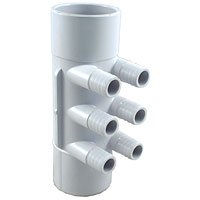
It's been pointed out to me that a better choice would be CPVC due to the high temperatures these systems can reach especially when not in use and the water is not moving.
Flow Gaurd MultiPort CPVC Manifold

By using several short lengths you will increase the effective diameter and reduce the resistance as well as the demands on your pump.
Don't forget to use a high temperature water pump. They are easy to find, but this is an important consideration that could be over looked.
Also the roof may look like an ideal place for a solar collector but you will have to have a pump tha can provide enough head pressure which will influence the cost of the pump and your choice of locations for the collector.
Tuesday, October 22, 2013
Your Local Grange
Until I read this story about the [California Grange being sued by the National Grange] I never gave a second thought to the Grange. To me it was just a big building where they held square dances, but this article [ What is the Grange? ] gives a much better description.
According to this article, the California Grange has begun to attract
"family sustainable farming". I'm guessing we backyard gardeners might fit that
description. The California Grange has also taken a stance against
GMO.
Rick Keel, a spokesman for the California State Grange recently said this “For lack of a better term, it seems to be ‘foodies’ who care about community today and see the Grange as a way to provide community service,”
"Since 1873 the California State Grange has championed the interests of farmers, ranchers, and rural Americans. The Grange stresses community service, and its Youth programs are open to all, urban and rural alike. There are over 185 chapters across the state. For more information contact the California State Grange at (916) 454-5805. " - California Grange
With the Farm to Fork movement catching on; aquaponics and the local Grange may be a very good combination. I'd like to encourage you to look into your local Grange for services. It may take a while to bring the National Grange around to supporting sustainable farming, but it has to start somewhere. The aquaponic and home gardening community have become forces of significant proportion. I think we can make a difference.
If you are already a member I hope you will vote Ed Lutrell The National Grange Master out of office in November because he strongly supports GMO.
 |
| Gwen Schantz is chief operating officer of the Brooklyn Grange rooftop commercial farm in Long Island City, Queens. |
Rick Keel, a spokesman for the California State Grange recently said this “For lack of a better term, it seems to be ‘foodies’ who care about community today and see the Grange as a way to provide community service,”
"Since 1873 the California State Grange has championed the interests of farmers, ranchers, and rural Americans. The Grange stresses community service, and its Youth programs are open to all, urban and rural alike. There are over 185 chapters across the state. For more information contact the California State Grange at (916) 454-5805. " - California Grange
With the Farm to Fork movement catching on; aquaponics and the local Grange may be a very good combination. I'd like to encourage you to look into your local Grange for services. It may take a while to bring the National Grange around to supporting sustainable farming, but it has to start somewhere. The aquaponic and home gardening community have become forces of significant proportion. I think we can make a difference.
If you are already a member I hope you will vote Ed Lutrell The National Grange Master out of office in November because he strongly supports GMO.
Sunday, October 13, 2013
Microbial Fuel Cell
On October 4th 2013 I began an experimenting with Microbial Fuel Cells. My initial experiment consisted of a piece of carbon fiber cloth 36” x 4” which I placed in the water of my aquaponic system. The bacteria grew on this cloth. After nine days I measured the voltage at .97 millivolt (mv) using a stainless steel cathode of approximately 6"x8" .
 http://backyardaquaponics.com/forum/viewtopic.php?f=31&t=17566&p=416193#p416193
While there are some similarities Microbial Fuel Cells are not the same as a BEAMR (BioElectrochemically Assisted Microbial Reactor) which is basically a Hydroxy gas generator.
Several years ago I was very involved with the creation of Hydroxy gas. Commonly known as HHO or Browns Gas. By using electrolysis and electrolyte such as KOH (Potassium Hydroxide) water is separated into hydrogen (H2) and oxygen (O2) in a 2:1 molar ratio. These two gases violently wish to be reunited and all it takes is a spark. This gas has some good applications, but it requires more power to create the hydroxy gas than the gas will return as a fuel source. Some people have found benefit when injected along with fuel into engines that do not have
I mention this because you may find this technique while researching Microbial Fuel Cells and fall victim to the misguided ideas surrounding the creation of hydroxy gas.
Microbial Fuel Cells are batteries created by the energy produced by the bacteria. I can't say it any better than what has been written on Wikipedia so I will quote the entire first paragraph.
"A microbial fuel cell (MFC) or biological fuel cell is a bio-electrochemical system that drives a current by mimicking bacterial interactions found in nature. MFCs can be grouped into two general categories, those that use a mediator and those that are mediator-less. The first MFCs, demonstrated in the early 20th century, used a mediator, this is a chemical that transfers electrons from the bacteria in the cell to the anode. Mediator-less MFCs are a more recent development dating to the 1970s; in this type of MFC bacteria in mediator-less MFCs typically have electrochemically active redox proteins such as cytochromes on their outer membrane that can transfer electrons directly to the anode.[1] Since the turn of the 21st century MFCs have started to find a commercial use in the treatment of wastewate"

While there are some similarities Microbial Fuel Cells are not the same as a BEAMR (BioElectrochemically Assisted Microbial Reactor) which is basically a Hydroxy gas generator.
Several years ago I was very involved with the creation of Hydroxy gas. Commonly known as HHO or Browns Gas. By using electrolysis and electrolyte such as KOH (Potassium Hydroxide) water is separated into hydrogen (H2) and oxygen (O2) in a 2:1 molar ratio. These two gases violently wish to be reunited and all it takes is a spark. This gas has some good applications, but it requires more power to create the hydroxy gas than the gas will return as a fuel source. Some people have found benefit when injected along with fuel into engines that do not have
I mention this because you may find this technique while researching Microbial Fuel Cells and fall victim to the misguided ideas surrounding the creation of hydroxy gas.
Microbial Fuel Cells are batteries created by the energy produced by the bacteria. I can't say it any better than what has been written on Wikipedia so I will quote the entire first paragraph.
"A microbial fuel cell (MFC) or biological fuel cell is a bio-electrochemical system that drives a current by mimicking bacterial interactions found in nature. MFCs can be grouped into two general categories, those that use a mediator and those that are mediator-less. The first MFCs, demonstrated in the early 20th century, used a mediator, this is a chemical that transfers electrons from the bacteria in the cell to the anode. Mediator-less MFCs are a more recent development dating to the 1970s; in this type of MFC bacteria in mediator-less MFCs typically have electrochemically active redox proteins such as cytochromes on their outer membrane that can transfer electrons directly to the anode.[1] Since the turn of the 21st century MFCs have started to find a commercial use in the treatment of wastewate"
A little more research indicates that a MFC
(Microbial Fuel Cell) must use anaerobic conditions. In aerobic
conditions bacteria are free to use near by oxygen for the electron they
wish to transfer. The anaerobic condition leaves only the cathode
exposed to available electrons from oxygen. This creates the electrical
difference between the anode and the cathode.
But I did measure a very small voltage of 97 mv on Oct 12 2013, so maybe maybe the process would be better in an anaerobic condition, but still prove viable in aerobic conditions. I'll come back to this in a few weeks and post the results. It may improve as the bacteria continues to grow on the cloth.
It was just two days ago that I measured 97 mv... I tested the voltage again today Oct 14 2013 and found that if I moved the cathode closer to the anode I could get 300 mv!
But I did measure a very small voltage of 97 mv on Oct 12 2013, so maybe maybe the process would be better in an anaerobic condition, but still prove viable in aerobic conditions. I'll come back to this in a few weeks and post the results. It may improve as the bacteria continues to grow on the cloth.
It was just two days ago that I measured 97 mv... I tested the voltage again today Oct 14 2013 and found that if I moved the cathode closer to the anode I could get 300 mv!
Subscribe to:
Posts (Atom)