Showing posts with label Bugs. Show all posts

Sunday, December 23, 2012

Green house pest management

Green house pest management can be an overwhelming problem; especially in an aquaponic system.   But these fungi are not limited to soil less gardens or greenhouses.


5427594
5427594
I'd like to thank Forestry Images for thier wonderfully helpful site.
With great photos to help identify various problems,  microscopic slides and petri dish samples they have made identification much simpler.

Pythium diseases (Pythium spp. ) on flue-cured tobacco (Nicotiana tabacum (flue-cured type)) - 1233227 Pythium diseases
brown spot (Alternaria alternata ) on flue-cured tobacco (Nicotiana tabacum (flue-cured type)) - 1402024 brown spot
Phytophthora blight (Phytophthora nicotianae ) on burley tobacco (Nicotiana tabacum (burley type)) - 1440052 Phytophthora blight Fusarium wilt (Fusarium oxysporum f.sp. nicotianae) on flue-cured tobacco (Nicotiana tabacum (flue-cured type)) - 1402044 Fusarium wilt
blue mold (Peronospora tabacina ) on burley tobacco (Nicotiana tabacum (burley type)) - 1440019 blue mold   powdery mildew (Podosphaera xanthii ) on squashes (general) (Cucurbita pepo ) - 1573677 powdery mildew leaf scorch (Diplocarpon earlianum ) on strawberry (Fragaria x ananassa ) - 5473250 leaf scorch sour rot (Geotrichum candidum ) on melon (Cucumis melo ) - 1575010 sour rot
white ear rot and seedling blight of maize (Stenocarpella maydis ) on corn (Zea mays ) - 5405277 white ear rot and seedling blight of maize bitter rot and anthracnose (Colletotrichum gloeosporioides ) on apple (Malus domestica ) - 5407832 bitter rot and anthracnose

Jon Parr and Vlad are some of the best contributors to the aquaponic  forums.
Here's a little advice they have pasted on that I appreciate.

Link to discussion

GH (Green House) pest management has three strategies, and which is best is really open for debate.
1- intentionally low pest security, meaning wide open large screens for honey bees, pests, and pest predators. This works pretty good for lazy folks like myself, especially if you are planting beneficial plants to attract the predators. No fuss about pollination, and no big concern about sterilizing everything.
2- moderate pest security. This one is fine for new greenhouses, and light traffic GH's with cleanly guests. Once a pest gets inside, though, trouble trouble.
3- high security, meaning positive pressure and HEPA filters, thrips screening, humidity and temp control, haz-mat suits and dissinfect routines. Just the thought of all that work spoils my mood, but is probably the smartest long term plan for commercial use.

I'm a low security type guy. Address the pest directly. Mold? Increase airflow and temp, decrease humidity. Spider mites, fungus gnats, white flies, aphids? Allow predators, spray with tea, nuke them with CO2. Nasturtiums are awesome for the garden by the way; trap crop or aphids, pest predator magnets, repel white fly and spider mites. Yep. And borage, and multicropping.

 Vlad Jovanovic
Link to discussion.
You can use the 'ol 3-5% oil + 0.5% dish washing detergent remedy...works well but you have to be real careful to get as little of the concoction into your system and take measure to cover up your FT to protect from overspray. And even this low % of oil will burn pepper plants if you have any...won't damage them beyond repair or anything, just don't be freaked out by the necrotic lesions that will be left on their leaves. peppers seem especially sensitive to this type of treatment.
A better/easier/more fish safe bet might be a naturally occurring fungus called Beauvaria bassiana that will take care of a whole host of common garden pests...spider mites included (and then some). B. bassiana can be purchased under the trade names Botaniguard, Naturalis-L or Mycotrol-O the later two being ok'd by OMRI...and more importantly it is fish safe (unlike any kind of oils or most soaps).
Whatever you spray with make sure to repeat after 3 or 4 days...then again after 3 or 4 days...and then once more...since most of these sprays wont kill the eggs that they've laid...so make sure you get the bastards that have hatched...and spray the under-sides of the leaves...Good luck. Spider mites are a royal PITA.
Here is a link to another in depth discussion about Botrytis cineria and Sclerotinia sclerotiorum
Botrytis blight (Botrytis paeoniae ) on peony (Paeonia officinalis ) - 5387709 Botrytis blight 
Sclerotinia rot (Sclerotinia sclerotiorum ) on cultivated tobacco - type unspecified (Nicotiana tabacum ) - 5424472 Sclerotinia rot


Wednesday, August 15, 2012

A Close Look


Paul Holowko is the Host and Producer of the TV show 'Gardening Rhythms'
'Gardening Rhythms' shows natural gardening methods,
scientific technology and organic methods for land & soil
creation and regeneration.  See website for times and
channels.

www.GardeningRhythms.com
Follow onTwitter  @pholowko" 


He has made many excellent presentations.  Below are a few of my favorites

Soil Food Web – Predator-Prey Protists Bacteria Fungi Microarthropods in an Aerobic Environment


Paul has also made a very nice web page for identifying garden bugs  CLICK HERE to identify pest by pictures

No Description

Video 1.
Published on Dec 28, 2012

The thin layer where soil and litter meet is especially crucial to this process. This layer of soil is the most biologically active; many species of microarthropods thrive only in the interface between soil and litter.
Video 2.
Published on Dec 28, 2012
Microarthropods video for a fly larva.
Microarthropods are important components of the soil decomposer food web. Organic matter is a major influence on microarthropod abundance and diversity. Conservation practices that increase soil organic matter improve soil quality by supporting the development of the soil biotic community. Microarthropods and other small soil animals are visible (sometimes barely so) but miniscule; most require some level of magnification for identification. Many microarthropods, especially springtails and soil mites, are responsible for breaking down organic material into a form that bacteria can consume, and are fundamental to the creation of humus and the formation of soil.

The thin layer where soil and litter meet is especially crucial to this process. This layer of soil is the most biologically active; many species of microarthropods thrive only in the interface between soil and litter.
Video 3.
Published on Dec 28, 2012
Protozoa are a diverse group of unicellular eukaryotic organisms. Protozoa were regarded as the partner group of protists to protophyta, which have plant-like behavior like photosynthesis. Below are some videos showing Protozoan in action. All videos are taken at 400X magnification. Some have flagellum (whip like tales) and others have cilium (hairy edges). As a cysts (can go dormant in bad times), protozoa can survive harsh conditions, such as exposure to extreme temperatures or harmful chemicals, or long periods without access to nutrients, water, or oxygen for a period of time.
Video 4.
Published on Dec 28, 2012
Bacteria are vital in recycling nutrients, with many steps in nutrient cycles depending on these organisms, such as the fixation of nitrogen from the atmosphere and putrefaction. In the biological communities surrounding hydrothermal vents and cold seeps, bacteria provide the nutrients needed to sustain life by converting dissolved compounds such as hydrogen sulphide (H2S)and methane (CH4).
Video 5.
Published on Dec 28, 2012
The nematodes or roundworms are traditionally regarded as the phylum Nematoda. Nematodes, (small worms) have successfully adapted to nearly every ecosystem from marine to fresh water, to soils, and from the Polar Regions to the tropics, as well as the highest to the lowest of elevations. The oral cavity is lined with cuticle, which is often strengthened with ridges or other structures, and, especially in carnivorous species, may bear a number of teeth. The mouth often includes a sharp stylet, which the animal can thrust into its prey. In some species, the stylet is hollow, and can be used to suck liquids from plants or animals.
Video 6.
Published on Dec 28, 2012
Protozoa are a diverse group of unicellular eukaryotic organisms. Protozoa were regarded as the partner group of protists to protophyta, which have plant-like behavior like photosynthesis. Below are some videos showing Protozoan in action. All videos are taken at 400X magnification. Some have flagellum (whip like tales) and others have cilium (hairy edges). As a cysts (can go dormant in bad times), protozoa can survive harsh conditions, such as exposure to extreme temperatures or harmful chemicals, or long periods without access to nutrients, water, or oxygen for a period of time.


Take a look at Dusan Beno's Bug Portraits Gallery.
Click this link then place your cursor on the pictures and click on the arrows to see all 20 pictures

Black Soldier Fly by Dusan Beno
Buzzer Midge by Dusan Beno

This is my favorite site for insect identification.  http://bugguide.net/node/view/15740

Wednesday, August 8, 2012

Midge AKA Chironomus riparius not Camallanus!

Thank you  John Malone and  Dr. George B. Brooks, Jr.  for your persistent help with this. 
You are correct.  It is Midge AKA Chironomus riparius not Camallanus!
I think the tell tale features are the body segments and the narrow pointy tail.

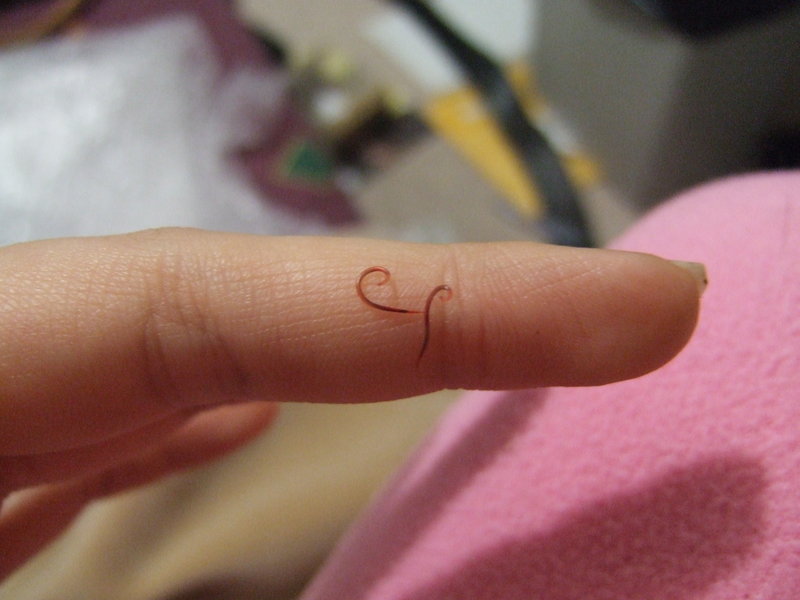
       Camallanus                               This is my worm                        Midge AKA Chironomus riparius


These worms are really small.  I had to take about 20 pictures to get just a couple that were any good.  These worms are so hard to see I had to wait until I could use full sunlight.

This is focused through the extra high magnification spot of a magnify glass.  My camera is set at maximum zoom and I still had to make it bigger with the computer!

I still moved the fish from the fish tank over to the raft tank.   I looked carefully to sex the fish, and looked for protruding camallanus.  None were found.    I was not very successful at determining the sex as they all seemed to have two holes.  Maybe it's determined by how close together those holes are. 

In any case I'm very happy to have them in a tank where I can view them.  I plan to rebuild my 800 gallon tank to a depth of only 18" with an extra 8" to the top edge of the tank.  That will make a 340 gallon tank. 

Two of the largest fish or maybe one really stupid fish jumped out today.  Dang that must have hurt because it's 4' to the floor. Is there a rule of thumb about how high the sides must be?


After reading about Midge I became absolutely certain because my grow room has been filled with what I thought were mosquitoes. Hundreds of them; I thought it strange that I never got bit.  They do not fly away when I place my finger on them, so I have been feeding them to the fish one at a time.

Thanks again for your help!

Monday, August 6, 2012

Camallanus Worms False Alarm

See my next post. 
This turned out to be Midge AKA Chironomus riparius not Camallanus!

Just one more learning experience.
Any advice?


UPDATE:
Comment by Jim Troyer
Found this Bob:

from:  http://plecoplanet.com/?page_id=48
How to treat for Camallanus Worms For more information on worms you can also check out this article http://www.plecofanatics.com/articles/showentry.php?e=321&catid=2